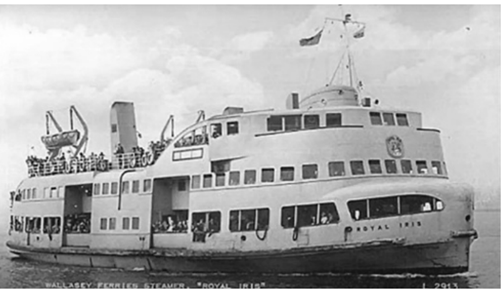
Back in those heady optimistic days of 1950s; of the Festival of Britain with its Skylon and other modernistic attractions, a purchase was made by Wallesey Corporation Ferries of a new vessel. Those of you who were around Merseyside between 1950 and 1991 will almost certainly have very clear memories of her with either a love or a hate recollection, she soon became known as the ‘Fish and Chips Boat’.
Of course I’m writing about the iconic cruise ferry named Royal Iris. She carried the ‘Royal’ prefix following the heroic action of her predecessor the 1906 built Iris which was requisitioned by the Royal Navy to take part in the Zeebrugge Raid, she along with another Mersey ferry, Daffodil, was towed across the English Channel to Zeebrugge. After the extreme bravery shown by both crews in the raid, she was renamed Royal Iris (and Daffodil also earned the Royal prefix) on command of King George V and they soon returned to the Mersey.
But getting back to the 1950s when ‘our’ Royal Iris was launched by Denny Bros., Dumbarton on 8 December 1950 and entered service on 5th May 1951. With a length of 159ft., beam of 48ft., draft of 9ft. and tonnage of1.234grt. Her four Ruston & Hornsby 4SA-6cylinder diesel engines powered four generators, each 300 kW/300v DC-connected to two electric motors, each 730shp and 2 shafts coupled to twin controllable pitch propellors gave a speed of 12knots. Her twin rudders provided enhanced manoeuvrability.
Originally painted in a green and cream livery, she carried the borough coat of arms on the front of the superstructure and was distinctive in having a forward dummy funnel near the bridge and two exhaust stacks amidships, on both sides. Licensed to carry 2,296 passengers on normal ferry duties, or 1,000 for cruising her onboard amenities included a dancefloor and stage, tea room, buffet, cocktail bar, even a fish and chip saloon (hence the nickname “the fish and chip boat”).
During the 1960s numerous acts associated with the Merseybeat scene performed on the ferry. Duke Duval played on the first Cavern Cruise, followed by The Beatles and Gerry & The Pacemakers. Paul McCartney referenced performing with the Beatles on the ferry in his song “That Was Me”.
On 1 December 1969, ownership of Royal Iris transferred to the newly formed Merseyside Passenger Transport Executive making a fleet of seven vessels. During a refit at the Harland and Wolff in Bootle in 1971-72, and now sporting a new blue and white livery, she was subsequently used, almost exclusively, as a cruise vessel. She was also provided for a new steak bar and dining area, replacing the original fish and chip saloon. On 21 June 1977, Royal Iris carried Queen Elizabeth II and the Duke of Edinburgh on their Silver Jubilee Mersey Review.
She was used by Granada Television during the summer of 1980 as the setting for the ITV Saturday morning children’s television series The Mersey Pirate. For this, a dome structure was built on the promenade deck of the vessel.
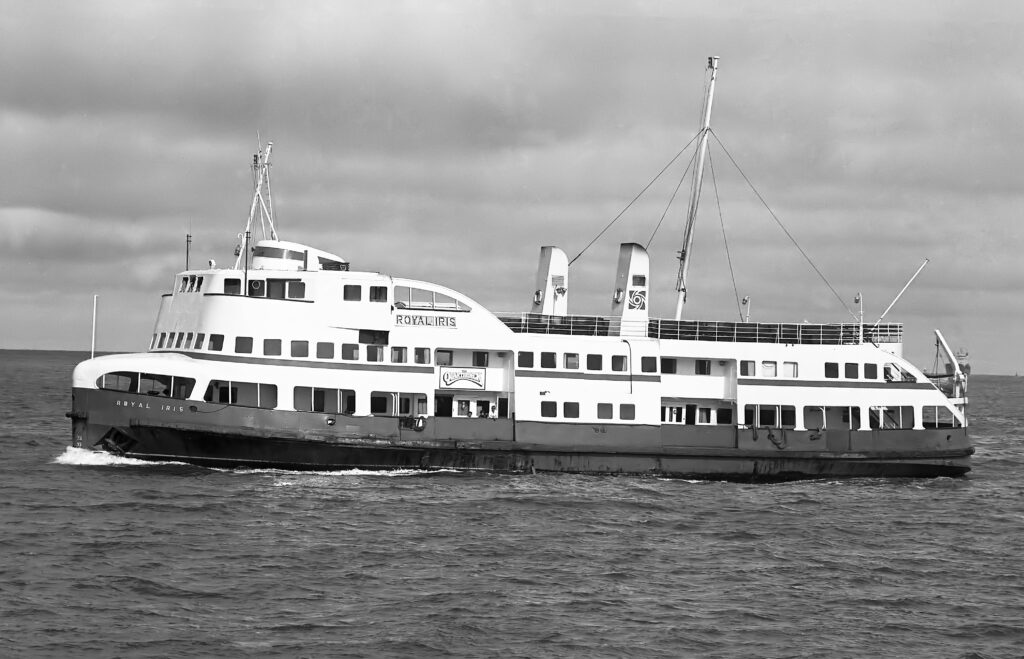
During 1984 Royal Iris and the other three Mersey Ferries received the red, white and blue livery to mark the 1984 International Garden Festival at Otterspool. In April and May 1985 the vessel left Liverpool Bay for the first time since the delivery from Scotland. Sent on a 1500-mile round trip to London on a publicity drive for Merseyside, sailing around Land’s End, up the River Thames , docking adjacent to HMS Belfast.
During the early 1990s, Mountwood, Woodchurch and Overchurch were given major refurbishments, including provision for cruising duties. The ageing Royal Iris, the last ex-Wallasey vessel, was considered surplus to requirements because of the cost of bringing her up to modern standards. Over the passing years she had become slower and more expensive to maintain.
Royal Iris ran a farewell evening cruise on 12 January 1991, and laid up awaiting confirmation of her fate. On 21 April 1991, she was granted a one-day licence from the Department of Transport to carry 600 people on a cruise to mark the 73rd Anniversary of the Zeebrugge Raid of 1918. On 16 August 1991, she was placed in the hands of shipbrokers SC Chambers Limited of Liverpool for an asking price of £100,000.
Sold in November 1991, to a consortium for conversion into a floating nightclub, restaurant and conference centre, based in Liverpool under the name of ‘Mr Smith’s Nightclub’, she was berthed in Stanley Dock in early 1992 to begin a new life on Merseyside and was subsequently painted Bright Blue with a red band around the top deck windows.
On 7 August 1993, the Liverpool Echo carried front page news that Royal Iris had been sold to Parkway Leisure who had the intention of turning her into a floating nightspot in Cardiff, planning to spend £300,000 on refitting. On 10 August 1993, the Royal Iris left Stanley Dock under tow, firstly going up river to the Pier Head for a final goodbye. Finally left the River Mersey for the last time, under tow, on the morning of 12 August 1993, for the passage to Cardiff.
Just twelve months later it was reported that Cardiff Council had rejected a planning proposal for the use of the vessel. No work had been carried out and berthing charges had not been paid. A spokesman for the new owners, Parkway Leisure, reported that they were ‘open to offers’.
In January 1996, a Liverpool based appeal to bring Royal Iris back to the Mersey and make her seaworthy again was mooted, but did not come to fruition.
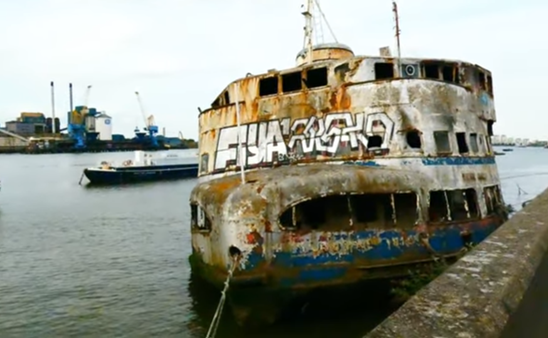
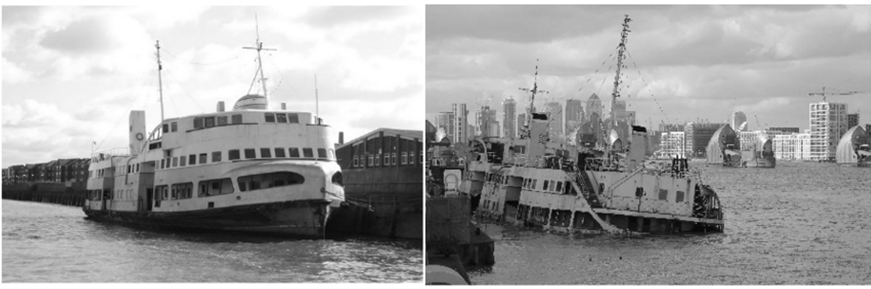
In 2002 the vessel was towed from Cardiff to a berth on the River Thames near Woolwich, awaiting a possible refit as a floating nightclub. Here she continued to deteriorate for another eight years!
On 6 February 2010, the Police and the RNLI were called out to her berth, after a passing vessel noticed Royal Iris had taken on water up to the passenger deck. In effect she had sunk. It was unclear how long this state had existed and there was evidence found to suggest that squatters had been living on board. Since that time the incoming tide has filled her so she remains on the bottom, then the outgoing tide releases that water.
In February 2010, the Liverpool Echo carried an article about an unnamed Wirral businessman who wished to purchase her, and on 4 March 2010, the Echo referred to an online petition to have her returned to Merseyside. On 9 March 2010, James Jegede, the current owner of Royal Iris, spoke to BBC Radio Merseyside about his plans.
Clearly all of this came to naught because in 2014, Royal Iris was still settled on the mudbank with a hole in her lower side. The cost of taking the vessel back to Merseyside was estimated to be a significant six figure sum, and, according to a local Member of Parliament, was unlikely to go ahead.
On the 9th April 2025, it was reported that a fire had broken out, gutting most of her remaining interior. Sadly that is how she still remains.